
COPRA FEA RF 2026.1 - Release and Web-Seminar
The 2026.1 release introduces performance improvements, enhanced robustness, and usability upgrades, enabling faster simulations and a more streamlined workflow.
New Release Highlights
In this 9-minutes recording of our release Web-Seminar, our expert Lander Arrupe will show you the highlights of this release and take you through all the new and improved software features of COPRA FEA RF 2026.1
New
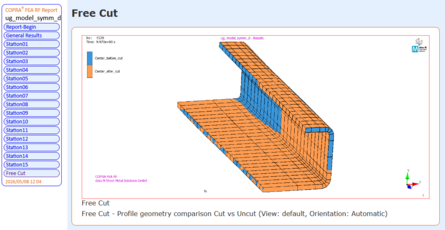
Free Cut Available as a Station in Automatic Report and Navigation:
The Free Cut operation is now interpreted as a station within COPRA FEA RF navigation and Automatic Report functionalities. This allows users to navigate directly to the Free Cut operation at the end of the simulation and improves the overall workflow when reviewing simulation results.
In addition, Automatic Reports now include a dedicated chapter for Free Cut results, providing a clearer and more organized post-processing experience.
This feature was introduced following valuable feedback from COPRA FEA RF users and reflects our ongoing commitment to continuously improving the software based on customer needs and suggestions.
Improved
Faster Simulations with Improved Solver Performance:
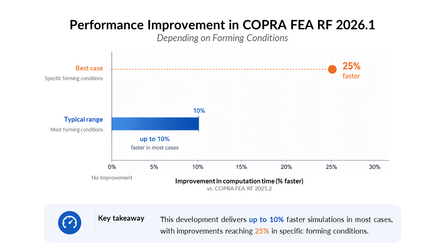
Simulation performance has been improved by optimizing key numerical parameters. Internal benchmarks show computation time reductions up to 10%, with improvements of up to 25% observed in specific cases. This enhancement enables faster iteration cycles, allowing users to reach results more efficiently and accelerate the overall development process.
Improved Start Station Simulations with Flat Mesh Initialization:
Start station simulations have been enhanced to significantly improve usability and workflow flexibility. The “Start Station” functionality allows users to simulate specific sections of the roll forming line without starting from the flat sheet. This can be used to reduce simulation time or to analyze stations even if preceding stations are not yet designed—often because their design depends on the forming behavior of subsequent stations.
In previous versions, manual mesh modifications at the start station had to be performed on an already formed (non-flat) geometry. This made mesh editing more complex and time-consuming.
With the new approach, the mesh is now initially created in a flat configuration. Users can apply manual mesh modifications more easily, before the mesh is automatically transformed into the selected start station geometry before the simulation begins.
Enhanced Advanced Cross-Section Analysis:
(Professional Version)
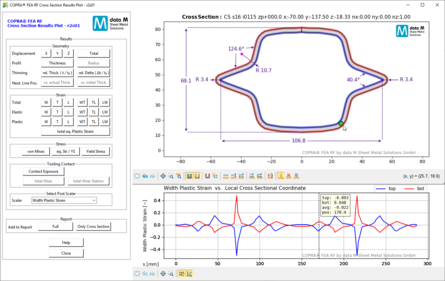
The advanced cross-section analysis tools have been further improved for better performance and usability. The feature is now faster and supports simulations starting from closed profiles, such as round-to-shape processes. Additionally, interactive highlighting has been introduced: when hovering over the cross section, the corresponding position in the result plot is automatically indicated. This direct correlation makes it easier to interpret local results and understand how values evolve along the profile. In the example shown, the highlighted point in the cross section is marked and simultaneously reflected in the diagram below, helping users quickly identify and analyze critical areas. These improvements provide a more intuitive and efficient analysis experience.
Increased Robustness in Restart Handling for Roll Modifications:
Restart simulations have been improved to better handle roll changes after the restart position. The updated implementation increases robustness and stability, ensuring more reliable continuation of simulations even in complex scenarios. Users benefit from smoother workflows and reduced risk of inconsistencies after restarting.
New
New Post-Processing Result in COPRA FEA RF WireRolling:
A new post-processing result, Stress Triaxiality, is now available for wire rolling simulations. This result provides deeper insight into the stress state of the material, supporting a better understanding of material behavior and failure tendencies during the forming process. It enables more advanced analysis and improved process optimization.